CNC Workshop Guide
CNC Router Dust Collection: Shop Vac vs. Dust Collector — What Should You Buy?
Running a CNC router without effective dust collection quickly turns your workshop into a hazardous snow globe of chips and microscopic airborne particles. Unlike a table saw or handheld plunge router, which operates for seconds or minutes at a time, a CNC router frequently carves for hours unattended. During a single pocketing operation in medium-density fiberboard (MDF) or hardwood, the spinning endmill pulverizes solid stock into millions of fine, respirable particles that settle onto linear rails, lead screws, electronics, and your lungs.
Many beginners assume that plugging their existing wet/dry shop vacuum into a 3D-printed or aftermarket dust boot solves the problem completely. Others spend hundreds of dollars on a high-flow woodworking dust collector only to discover that choking a 4-inch collector down to a 2.5-inch dust shoe reduces airflow so severely that chips spew across the wasteboard.
The truth is that CNC dust collection is an engineered airflow system, not an arbitrary shopping decision. Whether a shop vacuum, a dedicated HEPA dust extractor, or a high-volume cyclonic dust collector makes sense depends entirely on your machine size, dust boot port diameter, cutting materials, and duty cycle. This guide breaks down the physics of static pressure versus cubic feet per minute (CFM), evaluates manufacturer-documented hardware, reviews occupational safety standards, and helps you configure an effective, reliable extraction setup without overspending.
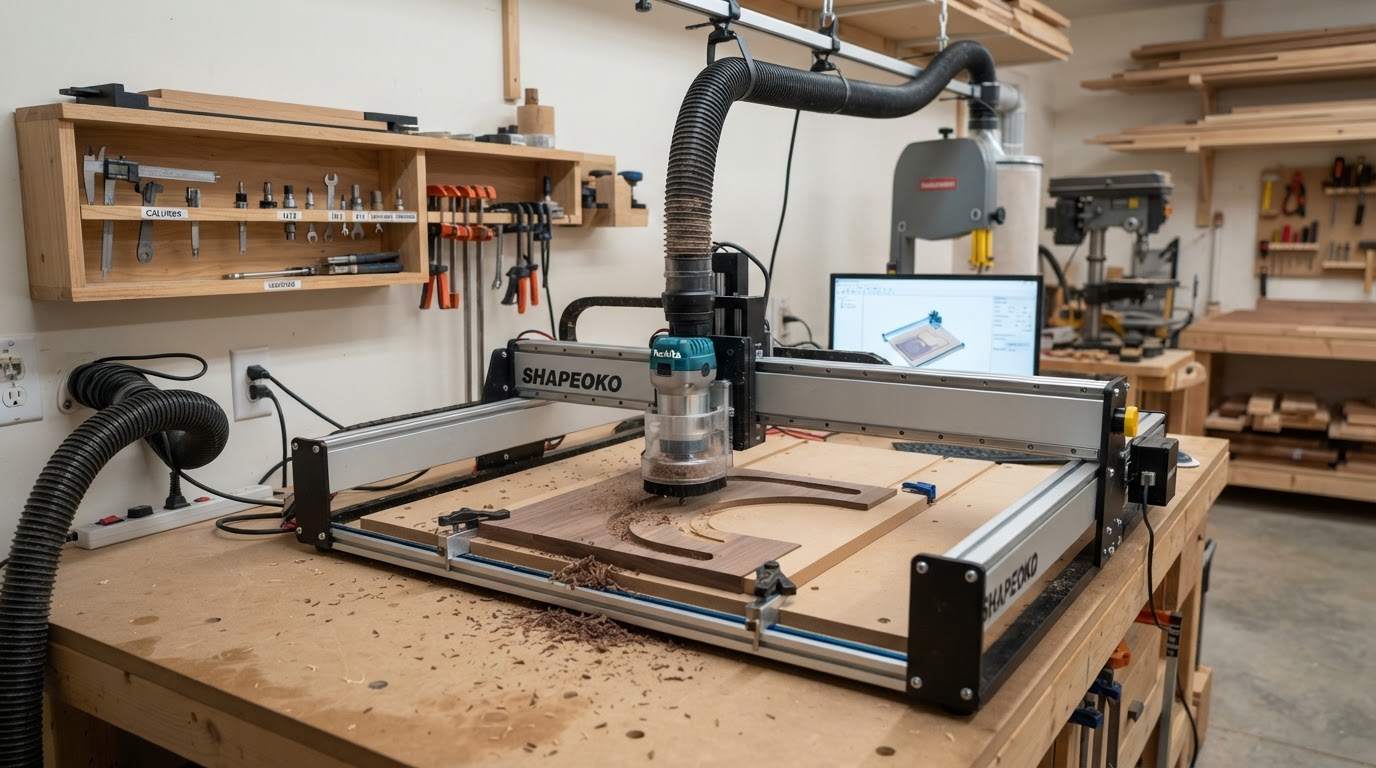
Quick Answer: Shop Vac or Dust Collector?
There is no universal 'best' dust collection system for every CNC router. The correct choice depends on your machine's physical size, the port diameter of your dust boot, the volume of material removed per hour, and whether you are cutting high-hazard particulate such as MDF or composite resins.
The fundamental rule of thumb in CNC extraction comes down to port size and static pressure. High static pressure moves air through narrow, restrictive hoses (1.25 inches to 2.5 inches), while high CFM moves large volumes of air through wide, low-resistance ducts (4 inches and larger). Matching your collector's operating curve to your dust boot's geometry determines whether your system captures chips at the source or merely makes loud noise while debris scatters.
Desktop & Hobby CNC Routers (Up to 4×4 ft) with 2.5-inch or Smaller Ports
Desktop machines like the Shapeoko, X-Carve, or Onefinity use dust boots engineered for 1.5-inch, 35mm, or 2.5-inch hoses. Standard woodworking dust collectors produce insufficient static pressure to pull air through narrow 2.5-inch flexible hoses. A high-static-pressure shop vacuum or tool-triggered dust extractor paired with an auxiliary cyclone (such as an Oneida Dust Deputy or Mullet Cyclone) captures chips and protects the vacuum filter from rapid blinding.
Full-Sheet CNC Routers (4×8 ft and Larger) with 4-inch or Larger Dust Boots
Commercial and heavy production CNC routers use high-power spindles (2.2 kW to 9 kW) and aggressive feed rates that produce immense chip volume. Their dust boots feature 4-inch to 6-inch exhaust ports. A traditional 1.5 HP to 3 HP dust collector generates the 400 to 800+ CFM required to evacuate large chips over wide cutting envelopes without choking.
Frequent MDF, Phenolic, or Carbon Composite Cutting
MDF resins and composite dusts contain hazardous sub-micron respirable particulate. Standard shop vacuums with basic pleated paper filters allow fine particulate to pass straight through the exhaust motor back into your ambient shop air. If cutting MDF regularly, source capture must be backed by true HEPA filtration (99.97% retention at 0.3 microns) in a sealed housing.
Multi-Machine Workshops with Shared Ductwork
If your CNC shares workshop space with a table saw, planer, and bandsaw, a centralized 2 HP to 5 HP cyclone collector with smooth-wall rigid metal ductwork and blast gates is the most economical long-term infrastructure, provided the drop to the CNC is stepped down correctly.
Why CNC Dust Collection Matters
Dust collection on a CNC router is frequently treated as an afterthought or a convenience feature to save sweeping time. In reality, effective dust evacuation impacts four distinct operational pillars: respiratory health, fire safety, machine reliability, and surface finish quality.
Because CNC routers carve materials by rotating multi-flute endmills at 10,000 to 24,000 RPM, the cutting mechanics differ substantially from low-speed hand tools. The tool's peripheral edge shears wood fibers into microscopic chips and fine aerosols of cell wall fragments. When chips linger in the cut groove rather than being instantly pulled away, the spinning tool recuts the same debris, converting coarse shavings into ultra-fine respirable dust while dramatically increasing frictional heat.
Respirable Wood & MDF Particulate
Particles smaller than 10 microns (PM10) and especially those smaller than 2.5 microns (PM2.5) remain suspended in workshop air for hours. They penetrate deep into alveolar lung tissues. Hardwood dust is classified by OSHA and IARC as a known human carcinogen, while MDF contains cured urea-formaldehyde or polymeric diphenylmethane diisocyanate (PMDI) binders that irritate mucous membranes.
Mechanical Wear & Lost Steps on Linear Axes
Airborne dust settles onto V-wheels, linear profile rails, ball screws, and belts. Mixed with machine lubricating oils or grease, wood dust forms an abrasive slurry that accelerates mechanical wear, introduces axis backlash, and can cause stepper motors to skip steps during rapid repositioning.
Recutting, Heat Buildup & Tool Wear
When a dust boot fails to clear chips from deep slots or pockets, the router bit recuts its own debris. This secondary cutting friction generates severe heat, dulling carbide cutting edges prematurely and causing burn marks along edge faces in woods like cherry and maple.
Combustion & Static Discharge Hazards
Finely divided dry wood and plastic dust suspended inside hoses and collection bins creates a risk of ignition. Rapid movement of non-conductive particles against plastic hose walls generates intense static electricity. Uncontrolled static discharge can zap machine electronics or spark in combustible dust concentrations.
Shop Vac vs. Dust Collector vs. Dust Extractor
To choose the right extraction system, you must understand the trade-off between static pressure (measured in inches of water lift) and airflow volume (measured in cubic feet per minute, or CFM). No single machine excels at both extremes.
| System Category | Typical Strength | Typical Limitation | Port & Hose Sizing | Best-Fit CNC Application |
|---|---|---|---|---|
| Standard Wet/Dry Shop Vacuum | High static pressure (50–80+ in. H2O); inexpensive; compact footprint; readily available. | Very low airflow volume (80–140 CFM open, drops sharply under load); extremely noisy universal motors; rapid filter clogging without pre-separation. | Optimized for 1.25" to 2.5" hoses; cannot support 4" ducts without losing capture velocity. | Hobby desktop CNCs (under 30" travel) using 2.5" dust boots, cutting solid wood or plastics occasionally. |
| HEPA Dust Extractor (Festool, Fein, etc.) | Certified sealed-unit HEPA filtration; auto-tool start triggering; continuous-duty rated motors; quieter operation. | High initial purchase cost ($400–$1,000+); modest airflow volume (130–160 CFM); smaller collection container capacity (5–12 gallons). | Engineered for 27mm, 35mm, or 36mm smooth anti-static vacuum hoses. | Enclosed desktop CNC routers, makerspaces, clean home workshops, and precision composite carving. |
| High-Pressure Cyclone Extractor (Oneida Dust Cobra) | Combines extreme static pressure (up to 70–90+ in. H2O) with cyclonic pre-separation and certified HEPA filtration; 14–35 gallon drum capacity. | Substantial investment ($1,500–$2,200+); larger physical footprint than portable vacuums. | Specifically designed for long runs of 2.5" flex hose down to 1.5" ports, or single 4" branches. | Dedicated benchtop and mid-sized CNCs running long cycles in high-hazard MDF, hardwoods, or plastics. |
| High-Volume Dust Collector (1.5 HP to 3+ HP) | Immense airflow volume (600–1,200+ CFM); quiet induction motors rated for continuous industrial duty; large collection bags or drums. | Very low static pressure (8–12 in. H2O); performance collapses completely if choked down below 3.5" diameter. | Requires minimum 4" (preferably 5" or 6") smooth-wall ducting and low-restriction dust shoes. | Full-sheet production CNC routers (4×4 ft, 4×8 ft, 5×10 ft) with large 4"+ dust boot collars. |
The physics distinction is critical: A shop vacuum utilizes a high-speed universal motor to pull a tight vacuum (high static pressure), allowing it to pull air through narrow, restrictive hoses and tight nozzle gaps. However, it moves a relatively small total volume of air (typically under 120 CFM under realistic operational load).
In contrast, a standard woodworking dust collector uses an induction motor spinning a large-diameter radial impeller. It moves vast air volumes (700 to 1,200+ CFM) but has very weak static pressure (often only 8 to 11 inches of water lift). If you neck down a 4-inch collector hose into a 2-inch or 2.5-inch CNC dust boot, the severe aerodynamic resistance strangles the impeller. CFM plummets by 70% or more, velocity drops below the transport threshold, and chips fall out of the airstream right at the spindle.
How CNC Dust Collection Systems Work
A complete CNC dust collection setup is a closed mechanical pneumatic chain consisting of five distinct stages. A failure or bottleneck in any single stage degrades the performance of the entire system.
Understanding each stage helps you identify where airflow velocity is lost, where filters become blinded, and how to maintain consistent negative pressure directly around the endmill's cutting envelope.
Source Capture (Dust Boot & Brush Skirt)
The dust boot surrounds the spindle collet and workpiece surface. A flexible bristle brush skirt forms a dynamic physical barrier, keeping high-velocity chip ejecta localized within the boot's chamber so the airstream can entrain them.
Pneumatic Conveyance (Flexible Hose & Overhead Support)
The flexible hose conveys entrained dust and chips from the moving gantry to the stationary collection unit. Corrugated hose interiors create high friction losses, meaning hose length, inside diameter, and bend radius directly dictate pressure drop.
Cyclonic Pre-Separation (Centrifugal Action)
An auxiliary cyclone separator spins incoming air in an inverted cyclonic vortex. Inertia flings 95% to 99% of heavy chips and coarse dust outward against the cylinder wall, dropping them into a catch bin before air ever reaches the vacuum filter.
Motive Power (Impeller or Vacuum Motor)
The blower or motor provides the negative pressure differential required to pull air through the system against all cumulative friction losses.
Filtration or Exhaust (Filter Media or Direct Venting)
The exhaust air must pass through pleated filter media (ideally rated MERV 16 or HEPA) to capture sub-micron particles before the air recirculates into the shop, or the air must be vented outdoors where local codes permit.
Important clarification: A cyclone separator is purely a particle separator, not a filtration or personal safety device. Centrifugal force effectively drops out particles above 10–20 microns, but sub-micron respirable dust easily passes through the vortex and directly into the secondary filter. Never vent a cyclone into ambient workshop air without certified downstream filter media.
Choosing a CNC Dust Boot or Dust Shoe
The dust boot (also termed a dust shoe) is the mechanical interface between your CNC spindle and the vacuum system. If capture fails at this interface, no amount of horsepower at the collector will keep your shop clean.
Dust boots generally divide into two fundamental architectural designs: spindle-mounted boots that move vertically with the Z-axis, and fixed-height (gantry-mounted) boots that maintain a consistent distance from the top surface of the workpiece regardless of plunge depth.
Spindle-Mounted vs. Fixed-Height Designs
Spindle-mounted boots attach directly to the router body (typically clamped to 65mm, 69mm, or 80mm spindle collars) and move up and down with the tool. They are simple and lightweight, but when making deep cuts, the brush skirt can compress hard against the stock, creating upward deflection forces on lightweight Z-axes. Fixed-height boots mount to the X/Z carriage and remain stationary relative to the workpiece top, ensuring the brush skirt never binds during deep pocketing.
Collar Mounting Diameter & Spindle Compatibility
Router bodies vary widely. Common trim routers like the Makita RT0701C and Carbide Compact Router require a 65mm collar; DeWalt DWP611 routers use 69mm; water-cooled or air-cooled VFD spindles typically require 65mm or 80mm clamps. Ensure the boot offers a precise, slip-free clamping mechanism that does not distort under vibration.
Brush Skirt Length & Flexibility
Bristle skirts range from 1 inch to 3 inches in length. Long, stiff bristles prevent chips from escaping but can lift thin workpieces or deflect miniature endmills. Flexible, split nylon bristles provide the best compromise between seal maintenance and lateral deflection resistance.
Magnetic Quick-Release for Bit Access
CNC routing requires frequent tool changes and Z-zero probing using touch plates. A dust boot with a magnetically detached lower housing allows you to expose the collet nut and collet in seconds without loosening hose clamps or tools.
Optical Visibility (Clear Polycarbonate)
Milled aluminum or opaque plastic dust shoes hide the cutter completely. Transparent polycarbonate housings allow you to visually monitor chip formation, verify proper cut initiation, and detect emergency workholding slips before severe damage occurs.
Compatibility Checklist Before Purchasing a Boot
- Verify your exact spindle body diameter (65mm Makita/Carbide, 69mm DeWalt, or 80mm industrial spindle).
- Confirm that the boot's physical width clears your machine's homing switches and Z-axis linear rail uprights at maximum travel.
- Ensure the hose outlet points toward your overhead cable track or boom arm without twisting the Z-axis cable harness.
- Check whether your machine uses automatic tool changers (ATC) or bit setters; standard boots must not collide with fixed tool probes on the wasteboard.
- Confirm the hose adapter matches your vacuum hose inside diameter (e.g., 2.5-inch shop vac, 35mm Festool, or 4-inch ducting).
Manufacturer-Documented Equipment Examples
To help you evaluate realistic workshop configurations, we reviewed current official documentation for representative dust boots and extraction systems from leading manufacturers. These examples represent distinctly different design architectures rather than a ranked commercial list.
Sweepy 2.0 Dust Boot
The Sweepy 2.0 is a refined spindle-mounted dust boot engineered for desktop CNC routers. It features a molded clear polycarbonate construction that provides clear visibility of the bit during carving. The lower portion detaches via neodymium magnets, making tool changes and collet wrench access effortless without disturbing the clamped mount. It also includes an affectionally named brush-free clear base ('Winston') specifically tailored for 3D relief carving and visual video recording.
Verified Manufacturer Specifications:
- Mounting / Inlet:
- 65mm (Carbide Compact / Makita), 69mm (DeWalt), and 80mm (VFD Spindle) variants
- Hose Connection:
- Standard 2.5-inch shop vacuum hose collar; includes adapters for 2.25" and 36mm Festool
- Construction:
- Clear molded polycarbonate body; neodymium magnetic detachable lower base; vertical sliding clamp
- Compatibility Note:
- Compatible with Shapeoko Z-axes and standard desktop spindles; mounts directly to spindle body without lost travel
Primary Advantages
- •Transparent polycarbonate construction offers clear cutter visibility.
- •Magnetic lower housing allows rapid tool changes without tools.
- •Ships with standard 2.5-inch hose port plus 2.25-inch and 36mm adapters.
- •Vertical adjustment along the spindle body accommodates varied tool stickouts.
Key Limitations
- •Spindle-mounted design causes the brush to compress downward as the Z-axis plunges into deep material.
- •Restricted to 2.5-inch and smaller vacuum hoses; not suitable for 4-inch collectors.
Best-fit user: Hobbyists and small workshop owners operating Shapeoko, Onefinity, or custom desktop CNCs using 65mm, 69mm, or 80mm spindles connected to standard shop vacuums.
Official Product DocumentationSweepy Pro Fixed-Height Dust Boot
The Sweepy Pro represents Carbide 3D's first purpose-built fixed-height dust boot. Unlike standard spindle-clamped boots, the Sweepy Pro mounts to a fixed position on the carriage assembly behind the gantry. Its vertical height is set relative to the workpiece using an underside thumbscrew. As the router plunges deeply into stock, the dust boot remains completely stationary on top of the stock, eliminating downward brush pressure, workpiece dragging, and Z-axis deflection.
Verified Manufacturer Specifications:
- Mounting / Inlet:
- Dedicated carriage mounting for Shapeoko HDM and Shapeoko 5 Pro machines
- Hose Connection:
- Fixed gantry rear hose connection; includes adapters for 2", 2.5", and 35mm hoses
- Construction:
- Clear polycarbonate bases; rigid fixed-height bracket; thumbscrew height adjustment; brush and brush-free bases included
- Compatibility Note:
- Shapeoko HDM and Shapeoko 5 Pro only (requires specific Z-axis mounting points; does NOT fit Shapeoko 3, 4, or Standard Pro)
Primary Advantages
- •Fixed-height operation prevents brush skirt compression during deep passes.
- •Hose mounts securely to a stationary bracket behind the gantry, reducing lateral pull on the spindle.
- •Includes both bristled and brush-free clear polycarbonate bases.
- •Height can be slid upward out of the way when dust collection is not required.
Key Limitations
- •Strict machine compatibility limitation: only fits Shapeoko HDM and Shapeoko 5 Pro.
- •Manufacturer explicit instruction: boot must be removed or moved when performing tool changes.
Best-fit user: Owners of heavy-duty Shapeoko 5 Pro or HDM machines performing deep pocketing, 3D profiling, or multi-pass cutting where brush compression cannot be tolerated.
Official Product DocumentationX-Carve Dust Control System (Bundle)
The Inventables Dust Control System is a comprehensive accessory bundle designed specifically for the X-Carve. It incorporates a carriage-mounted dust shoe with a dense perimeter brush, a dedicated overhead support mast that elevates the vacuum hose to eliminate snagging on the worktable, and an integrated grounding wire to dissipate electrostatic charges generated by friction inside the hose. While historically included in fully loaded packages, buyers must verify current replacement part availability.
Verified Manufacturer Specifications:
- Mounting / Inlet:
- Carriage-mounted dust shoe assembly engineered for X-Carve X-axis carriage
- Hose Connection:
- Grounded vacuum hose with universal shop vacuum fitting
- Construction:
- Removable dust shoe with bristle skirt; includes overhead hose support pole and grounding hardware
- Compatibility Note:
- Engineered for X-Carve machines; manufacturer explicitly documents that it is NOT available for X-Carves using Bosch spindles
Primary Advantages
- •Includes an overhead hose support pole that prevents hose dragging across the carving bed.
- •Features a grounded hose design to mitigate static electricity buildup.
- •Mounts directly to the X-axis carriage rather than clamping onto the spindle nose.
Key Limitations
- •Currently listed as 'Sold Out' on the official Inventables store; buyers may need to source replacement subassemblies individually.
- •Incompatible with Bosch spindle configurations.
Best-fit user: X-Carve operators seeking an engineered, factory-integrated dust management solution with overhead hose strain relief.
Official Product DocumentationDust Cobra High-Pressure Cyclone Dust Collector
The Oneida Dust Cobra is a specialized hybrid extraction system designed specifically for the unique aerodynamic challenge of small-port machinery. While conventional dust collectors move large volumes of air at low static pressure, the Dust Cobra delivers massive static pressure (nearly triple that of standard collectors) combined with an integrated high-efficiency steel cyclone and full-unit HEPA certification. It features a touchless reverse-air pulse cleaner that cleans the internal filter pleats in seconds without disassembly.
Verified Manufacturer Specifications:
- Mounting / Inlet:
- High-pressure cyclonic separation chamber; 2.5" inlet optimized for handheld tools and tabletop CNCs (supports single 4" ports)
- Hose Connection:
- 2.5" flex-hose inlet collar; freestanding mobile cart or wall-mount configurations
- Construction:
- Full-unit certified HEPA system; touchless reverse-air pulse filter cleaner; steel frame with 14-gallon or 35-gallon steel drums
- Compatibility Note:
- Universal application for benchtop CNC routers, drum sanders, and tools requiring extreme static pressure over small ports
Primary Advantages
- •Full-Unit HEPA Certification meets stringent occupational exposure guidelines.
- •Exceptional static pressure maintains velocity through long 2.5-inch CNC hose runs.
- •Integrated cyclone separator drops 99% of dust into a large 14- or 35-gallon steel drum before reaching the filter.
- •Reverse-air pulse filter cleaner dislodges fine caked dust without taking the unit apart.
Key Limitations
- •Substantial capital investment ($1,500+), exceeding the cost of entry-level CNC routers.
- •Not intended for multiple simultaneous open blast gates across a large industrial shop.
Best-fit user: Commercial workshop operators, schools, and serious makers carving high volumes of MDF or hardwood who require certified sub-micron containment and minimal filter maintenance.
Official Product DocumentationWhat Size Hose Does Your CNC Need?
Hose diameter is one of the most frequently misunderstood variables in CNC dust collection. Beginners often assume that installing a larger hose automatically improves performance. However, fluid dynamics dictates that air velocity is inversely proportional to cross-sectional area for a given volume of air.
If you attach a 4-inch hose to a shop vacuum that only produces 100 CFM, the air velocity inside that 4-inch hose drops to approximately 1,145 feet per minute (FPM). The minimum transport velocity required to keep heavy wood chips floating horizontally in an airstream is approximately 3,500 to 4,000 FPM. In a 4-inch hose powered by a shop vacuum, chips will rapidly settle to the bottom of the hose, forming an internal blockage until the entire line plugs solid.
1.25" to 1.5" (32mm–38mm) Hose
Miniature benchtop CNCs, PCB engravers, and tool-mounted extractors.
Generates very high capture velocity right at the nozzle tip, but exhibits extreme frictional resistance per foot. Keep total run lengths under 8–10 feet to prevent choking the vacuum motor.
2.5" (63.5mm) Hose
Standard desktop CNC routers (Shapeoko, X-Carve, Onefinity, Stepcraft).
The ideal sweet spot for high-static-pressure shop vacuums and cyclone extractors. At 110–130 CFM, air velocity inside a 2.5-inch hose remains above 3,200–3,800 FPM, easily keeping sawdust, MDF powder, and hardwood shavings airborne over 15–20 foot runs.
4" (100mm) Flexible Ducting
Mid-sized to full-sheet CNC routers connected to 1.5 HP to 2 HP dust collectors.
Requires at least 350 to 450 CFM from the collector to maintain transport velocity (4,000 FPM). Never neck down a 4-inch collector hose to a 2.5-inch dust shoe at the machine, as this creates a severe aerodynamic restriction that starves the impeller.
5" to 6" (125mm–150mm) Rigid Duct / Heavy Flex
Commercial production routers (3 HP to 10 HP industrial systems).
Provides massive chip volume conveyance (600–1,200+ CFM) with minimal friction loss, capable of evacuating heavy nesting and panel cutting operations without heating.
Important physics rule: Never connect a large-diameter hose through a small, restrictive adapter at the vacuum. Adapters create turbulent vena contracta restrictions that destroy static pressure. Match the hose size to the collector's design curve and the dust shoe's inlet diameter.
Do You Need a Cyclone Separator?
If you operate a CNC router using a standard shop vacuum or dust extractor without an auxiliary cyclone pre-separator, you will quickly face an expensive and frustrating maintenance cycle. A CNC carving session can fill a standard 5-gallon vacuum canister in two hours, completely packing the pleated cartridge filter with fine wood flour.
As fine dust cakes onto the pleated filter (a condition known as blinding), airflow drops precipitously. Within 30 minutes of carving MDF, a vacuum's effective CFM can drop by 50% to 70%, allowing chips to spew across your machine bed. An auxiliary cyclone separator solves this problem mechanically.
Advantages of a Cyclone Separator
- ✓Separates 95% to 99% of bulk chips and fine dust before air reaches the vacuum filter.
- ✓Maintains near-constant suction and airflow throughout multi-hour carving jobs.
- ✓Extends the operational lifespan of expensive pleated and HEPA filters by months or years.
- ✓Allows easy disposal from lightweight 5-gallon buckets or 14-gallon drums rather than emptying the vacuum housing.
Trade-offs & Considerations
- •Adds an additional mechanical component and footprint to your shop layout.
- •Introduces slight aerodynamic pressure drop across the cyclone body (typically 1.5 to 3 inches of water lift).
- •Collection drum must be 100% airtight; even a pinhole leak in the drum lid will ruin cyclonic separation efficiency.
Verdict: For any CNC router running off a shop vacuum or portable extractor, an auxiliary cyclone separator (such as an Oneida Dust Deputy, Mullet Cyclone, or DIY cyclone lid) is virtually mandatory. It is the single most cost-effective upgrade you can make to your extraction setup.
Filtration and Wood-Dust Safety
Wood dust is not merely an aesthetic nuisance; it is an occupational respiratory hazard with well-documented physiological consequences. Both the Occupational Safety and Health Administration (OSHA) and the National Institute for Occupational Safety and Health (NIOSH) enforce strict exposure limits for airborne wood particulate.
The most dangerous particles generated by a CNC router are invisible to the naked eye. Particles smaller than 2.5 microns (PM2.5) remain airborne indefinitely on ambient thermal currents. When inhaled, these fine particles bypass the nasal passages and bronchial cilia, penetrating deep into the unciliated alveoli where gas exchange occurs.
Hazardous Respirable Dust Notice (MDF & Composites)
Special Warning Regarding MDF and Engineered Composites: Medium-density fiberboard consists of wood fibers bonded under intense heat and pressure with synthetic resin adhesives—most commonly urea-formaldehyde or polymeric methylene diphenyl diisocyanate (PMDI). When cut at high spindle speeds, MDF fractures into microscopic airborne dust containing residual free formaldehyde and resinous compounds. Exposure can trigger acute respiratory irritation, allergic sensitization, and chronic asthma. Standard shop-vac paper filters DO NOT capture these microscopic resin particles. Always pair MDF machining with certified HEPA filtration and personal respiratory protection.
OSHA Permissible Exposure Limit (PEL)
OSHA establishes an 8-hour time-weighted average (TWA) PEL of 15 mg/m³ for total dust and 5 mg/m³ for the respirable dust fraction in general industry (29 CFR 1910.1000). Many health organizations recommend much stricter limits (1 mg/m³ for hardwood dust).
HEPA Standard (DOE / IEST)
True High-Efficiency Particulate Air (HEPA) filters must remove at least 99.97% of airborne particles measuring 0.3 microns in diameter. A certified 'Full-Unit' HEPA system guarantees that all air passing through the motor housing passes through the filter without bypass leakage around gaskets.
MERV Ratings (ASHRAE 52.2)
Standard dust collector filter bags often rate at MERV 5 to 8, capturing only coarse particles above 3 microns and exhausting fine sub-micron dust straight back into your shop. Upgrading to a MERV 15 or MERV 16 pleated canister filter captures 85%+ of particles between 0.3 and 1.0 micron.
Recommended Dust Safety Best Practices
- Never use compressed air blow guns to clear chips from your CNC bed or wasteboard; blowing dust aerosolizes settled sub-micron particulate, creating extreme exposure peaks throughout the shop.
- Upgrade wet/dry shop vacuums to manufacturer-certified HEPA pleated cartridges paired with high-efficiency synthetic fleece filter collection bags.
- For enclosed desktop routers, consider venting the vacuum exhaust outdoors through an exterior wall if local environmental codes and weather conditions permit.
- Wear a well-fitted half-mask respirator equipped with N100 or P100 particulate filters when clearing wasteboards, emptying cyclone drums, or changing filters.
- Maintain ambient workshop air filtration units (overhead ceiling scrubbers) to clean background particulate that escapes source capture.
Static Grounding Safety Note: Air conveying dry wood chips through non-conductive PVC or plastic spiral flex-hose generates intense electrostatic charges. While rare in small 2.5-inch hobby setups, static discharges can deliver severe shocks, damage sensitive CNC controller boards, and in extreme industrial conditions present a dust deflagration risk. Follow manufacturer recommendations: use anti-static conductive hose or run an external copper drain wire properly grounded to your machine chassis or building ground.
CNC Dust Collection Setup Checklist
Before initiating your first production job, run through this practical workshop setup checklist to ensure your dust extraction operates reliably without impeding machine motion.
- Mount the dust boot securely to the spindle or carriage and verify that the clamping screw is tight under operating vibration.
- Jog the CNC manually through its complete X, Y, and Z travel envelopes to ensure the dust boot does not collide with homing switches, clamps, or bit-setters.
- Inspect overhead hose suspension: ensure the hose has sufficient slack to reach all four corners of the bed without pulling sideways on the Z-axis carriage.
- Verify that the vacuum hose cannot droop into the cutting path or get pinched beneath the gantry linear rails.
- Check the magnetic lower shoe attachment: ensure the magnets are free of steel swarf or chips and hold the brush firmly in place.
- Inspect all hose clamp connections and cyclone drum lid seals for vacuum leaks; even minor air leaks reduce nozzle capture velocity.
- Verify electrical circuit capacity: ensure that your CNC controller, spindle, and vacuum/collector do not overload a single shared 15A or 20A breaker.
- Clean or inspect the cyclone collection bin before long jobs to prevent chips from backing up into the secondary filter.
10 Common Buying Mistakes
#1Buying by Advertised Horsepower (Peak HP Deception)
Many consumer shop vacuums claim '6.5 Peak HP' on a standard 120V 15A wall receptacle. Basic electrical physics dictates that a standard 120V 15A outlet can only deliver approximately 1,800 watts (roughly 2.4 continuous mechanical HP). Peak HP figures are marketing fiction based on momentary motor stall draw. Look at actual amp draw and verified CFM under static load.
#2Necked-Down 4-Inch Dust Collectors
Attempting to connect a standard 1 HP or 1.5 HP woodworking dust collector to a 2-inch or 2.5-inch desktop CNC dust shoe severely chokes the impeller. These collectors lack the static pressure to push air through narrow hoses, causing CFM to collapse and chips to spill out.
#3Ignoring Spindle Body Clamping Dimensions
Assuming all trim routers share identical diameters leads to loose or cracked boots. A 65mm boot will not fit a 69mm DeWalt, and an 80mm industrial VFD spindle requires a heavy-duty, purpose-designed mounting collar.
#4Equating Visible Chip Capture with Fine-Dust Safety
Just because the wasteboard looks clean does not mean the air is safe. Coarse 30-micron chips fall into the vacuum easily, while carcinogenic 1-micron dust blows straight through non-HEPA exhaust ports into your breathing zone.
#5Running Cyclones on Leaky Collection Drums
Cyclonic separation relies on a perfect pressure differential. If your 5-gallon bucket or drum lid has an air leak around the rim, air rushes upward from the bucket, carrying dust directly into the secondary vacuum filter.
#6Failing to Support the Hose Overhead
Allowing a 2.5-inch vacuum hose to drag across the CNC bed adds lateral friction, risks catching on hold-down clamps, and exerts uneven torque on lightweight desktop Z-axes, causing cut inaccuracies.
#7Compressing Brushes During Deep Z-Plunges
Using a spindle-mounted boot with extra-long, stiff bristles on deep pocketing jobs forces the bristles hard into the workpiece. This creates upward thrust that can deflect the cutter or lift thin sheet stock.
#8Machining MDF with Basic Paper Filters
MDF resin dust rapidly clogs standard paper filters, causing suction loss within minutes and releasing fine formaldehyde-laden particulate back into the workshop air.
#9Ignoring Replacement Filter Costs
Budgeting only for the machine and forgetting that certified HEPA filter cartridges cost $50 to $120+ each. Without a cyclone separator, you may burn through filters monthly.
#10Over-sizing the System for Small Spaces
Buying a noisy, 3 HP commercial dust collector for a tiny residential spare bedroom workshop. The electrical, spatial, and noise constraints will quickly overwhelm the hobby experience.
Budget & Total Cost of Ownership
Calculating the cost of CNC dust collection requires looking beyond the purchase price of the dust boot itself. A functional setup requires the boot, adapters, flexible hose, suspension hardware, motive power unit, pre-separation, and recurring replacement filter media.
The table below outlines realistic total cost of ownership across the primary workshop tiers. Prices reflect verified retail hardware configurations checked as of November 2026.
Budget Desktop Setup (Shop Vac + DIY Cyclone)
$180 – $280 Total (e.g., $55 Sweepy 2.0 boot + $60 12-gal shop vac + $60 Oneida Dust Deputy DIY kit + $30 hose/adapters)
Maintenance: $30–$50 per year for replacement HEPA pleated filters and synthetic fleece collection bags.
Prosumer Desktop Setup (HEPA Extractor + Fixed Boot)
$550 – $950 Total (e.g., $150 Sweepy Pro or premium boot + $450–$650 FEIN Turbo II or Festool CT MIDI + $80 Mullet/Oneida cyclone)
Maintenance: $60–$120 per year for certified HEPA cartridges and self-cleaning filter bags.
High-Pressure Commercial System (Oneida Dust Cobra)
$1,600 – $2,300 Total (e.g., $1,499–$2,149 Dust Cobra 14/35-gal unit + $80–$150 premium CNC dust shoe + 2.5" heavy-duty flex hose)
Maintenance: $80–$150 every 2–3 years (reverse-air pulse cleaning dramatically extends filter lifespan).
Full-Sheet Central Cyclone System (2 HP to 3 HP)
$1,800 – $3,500+ Total (e.g., $1,400–$2,400 2–3 HP cyclone collector + $300–$600 rigid metal ductwork + $150 4" CNC dust boot)
Maintenance: $100–$200 per year for heavy-duty plastic drum collection liners and canister filter replacement every 4–5 years.
Which Setup Fits Your Workshop?
Use this decision matrix to identify the ideal equipment combination based on your machine architecture, shop environment, and typical cutting materials.
| Workshop Profile | Suitable System Category | Dust Boot Requirements | Filtration Considerations | Likely Upgrade Path | Important Limitations |
|---|---|---|---|---|---|
| Occasional Desktop CNC Hobbyist (Garage / Basement) | Standard 10–14 gallon shop vac (120V) + auxiliary cyclone separator (Dust Deputy). | Spindle-mounted clear polycarbonate boot (65mm/69mm) with 2.5" hose connection and magnetic base. | Manufacturer HEPA cartridge installed in vacuum; synthetic fleece liner bags. | Add an overhead boom arm for hose management; upgrade to quieter extractor if noise bothers household. | High operational noise (80–85+ dBA); not rated for continuous multi-hour production without motor resting. |
| Enclosed Small Workshop / Makerspace | Tool-triggered HEPA dust extractor (Festool, FEIN, Bosch) + compact cyclone. | Clear boot with 35mm or 36mm smooth anti-static hose connection; brush-free or short bristle skirt. | Full-unit certified HEPA filtration; automated filter vibration/pulse. | Permanent soundproofing enclosure for the extractor; wireless remote switch. | Modest waste bin capacity (8–10 gallons); requires frequent emptying during deep carving. |
| Frequent MDF, Sign-Making & Cabinetry Carving | High-pressure cyclonic extractor (Oneida Dust Cobra) or dedicated 1.5 HP cyclone. | Fixed-height carriage-mounted dust shoe (prevents brush compression during deep passes). | Full-unit HEPA certification mandatory; reverse-pulse cleaning; sealed metal catch drum. | Exhaust duct routed outdoors; overhead ceiling ambient air scrubbers. | Higher initial equipment cost; requires dedicated 15A or 20A electrical branch circuit. |
| Multi-Machine Woodworking Shop (CNC + Planer + Saw) | Central 2 HP to 3+ HP stationary cyclone collector with rigid ductwork. | High-flow 4" collar dust shoe mounted to Z-carriage; flexible clear anti-static 4" urethane hose drop. | Large MERV 16 pleated spunbond polyester canister filter; manual or automatic filter crank. | Pneumatic or motorized blast gates tied to machine power sensors. | Cannot neck down to small 2.5" ports without stalling; requires dedicated 220V/240V power. |
CNC Dust Collection Buying Checklist
- What is the exact outer diameter of your router or spindle collar (65mm, 69mm, 80mm)?
- Does your machine's Z-axis design accommodate a fixed-height boot, or do you need a spindle-clamped boot?
- Does your dust boot have a magnetic quick-release base for rapid bit changing and Z-zero probing?
- What is the inside diameter of your extraction hose, and does it match your vacuum/collector without restrictive adapters?
- Do you have an auxiliary cyclone separator to capture 95%+ of chips before they blind your primary filter?
- Is your primary filter certified to HEPA standards (99.97% at 0.3 microns), especially if cutting MDF or composites?
- Do you have an overhead boom arm, ceiling bungee, or articulated mast to support hose weight across the entire travel envelope?
- Are your vacuum hose and machine frame properly grounded to dissipate electrostatic charges?
- Does your electrical panel support the combined simultaneous load of your router spindle, stepper drivers, and vacuum system?
- Do you have a half-mask P100 respirator on hand for emptying collection drums and servicing filters?
Final Recommendation
Effective CNC dust collection is never a matter of buying the biggest horsepower rating you can find. It is the disciplined alignment of five components: an aerodynamically efficient dust shoe, a matched flexible hose, an auxiliary cyclonic separator, an appropriately matched motive blower, and certified fine-particle filtration.
For the vast majority of desktop and benchtop CNC routers (under 4×4 feet), pairing a clear polycarbonate 2.5-inch dust boot with an auxiliary cyclone and a HEPA-equipped shop vacuum provides the best combination of capture velocity, footprint, and affordability. If you step up to full-sheet 4×8-foot production routers, invest in a proper 4-inch or larger high-volume cyclone collector with rigid ductwork.
Never compromise on respiratory protection. High-velocity carbide cutters turn woods and engineered resins into respirable aerosols. Prioritize source capture and HEPA filtration from day one, and your workshop will remain clean, your machine axes will run accurately, and your lungs will be protected for years of creative making.
Key Takeaways for Your Workshop
- Match port size to airflow type: High static pressure for 2.5-inch hoses; high CFM for 4-inch and larger ducts.
- Always add an auxiliary cyclone separator to protect your vacuum filters from rapid blinding.
- Prioritize clear polycarbonate dust shoes with magnetic quick-release bases for visibility and easy tool changes.
- Insist on true HEPA filtration whenever cutting MDF or composite materials.
- Support hoses overhead to prevent lateral drag on your Z-axis carriage.
Related CNC Routing Guides
Frequently Asked Questions
Sources & References
- Carbide 3D Sweepy 2.0 Official Product Documentation — Official specifications for 65mm, 69mm, and 80mm polycarbonate dust boot with 2.5-inch hose connection.
- Carbide 3D Sweepy Pro Official Product Documentation — Manufacturer specifications for fixed-height dust boot engineered for Shapeoko HDM and Shapeoko 5 Pro.
- Inventables X-Carve Dust Control System Official Store — Carriage-mounted dust shoe, overhead support mast, and grounded hose specifications for X-Carve.
- Oneida Air Systems Dust Cobra Product Documentation — High-pressure cyclonic dust collector specifications, full-unit HEPA certification, and pulse cleaner details.
- OSHA Wood Dust Health Hazards & Standards (29 CFR 1910.1000) — Occupational safety standards governing permissible exposure limits (PEL) for total and respirable wood dust.
- NIOSH Health Hazard Evaluation: Woodworking and Composite Particulate — Respirable particulate guidelines, particle sizing dynamics, and engineering control recommendations.
Digital Workshop Guide produces independent, research-backed educational and buying resources. We do not accept sponsored product placements or claim hands-on ownership of every machine. Learn more about our testing standards and independence in our Editorial Policy and Affiliate Disclosure.