Material compatibility reference
PETG Fabrication Compatibility
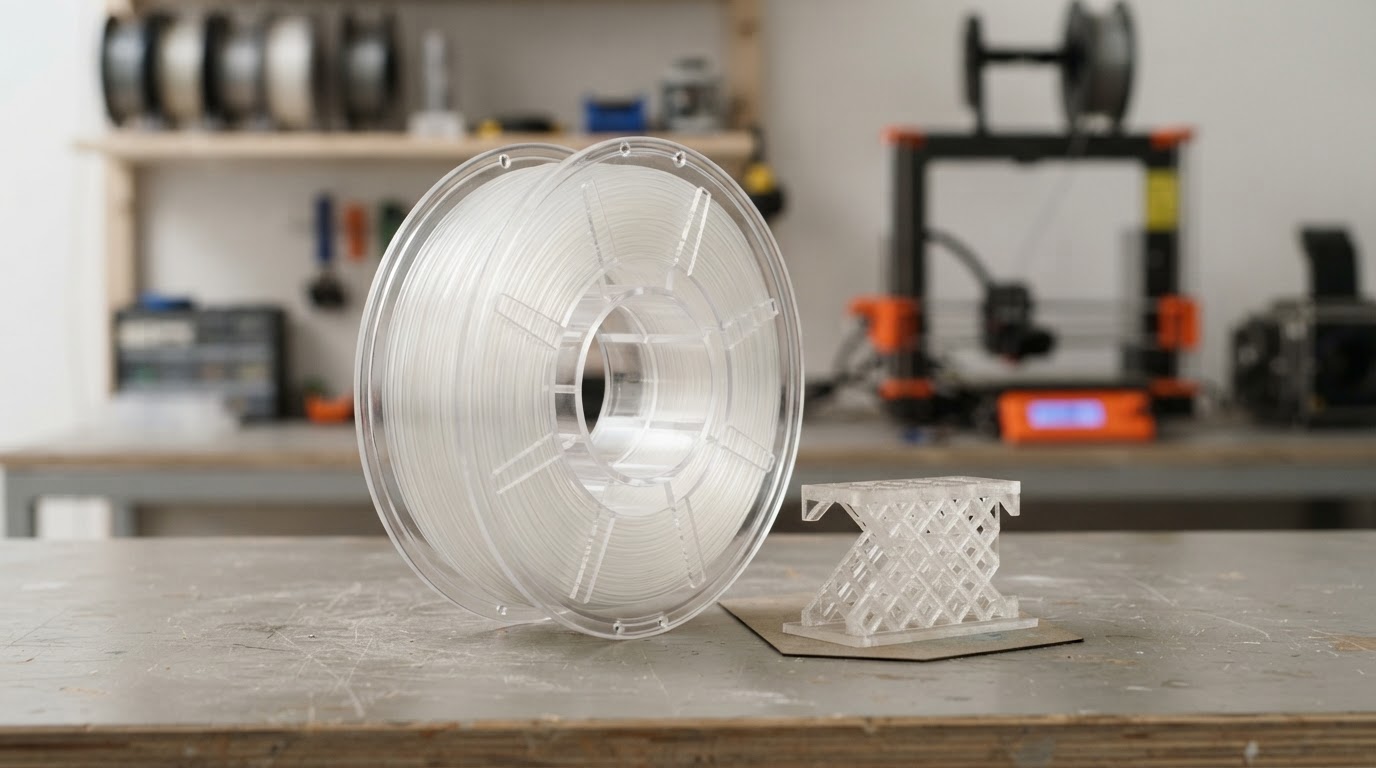
A glycol-modified copolyester used widely as FDM filament and as a clear sheet plastic. PETG is tougher and more heat-resistant than PLA, but it is a distinct material from PET and from acrylic — do not assume it behaves like another clear plastic under a laser. As a filament it is a popular FDM feedstock; as a sheet it can be laser-cut with care and ventilation.
Quick compatibility overview
How each digital fabrication technology relates to petg at a glance. See the sections below for detail.
- Diode LaserLimited — Possible but with significant constraints; often not the best choice.
- CO2 LaserConditional — Works, but depends heavily on machine, settings, or material specifics.
- Fiber LaserNot applicable — Not a meaningful combination for this material and technology.
- CNC RouterLimited — Possible but with significant constraints; often not the best choice.
- FDM 3D PrintingExcellent — A strong, well-suited match for this material.
- Resin 3D PrintingNot applicable — Not a meaningful combination for this material and technology.
Compatibility by technology
What each process can do with petg, important limitations, and safety considerations.
Diode Laser
Limited — Possible but with significant constraints; often not the best choice.Diode lasers can engrave some finished PETG parts, but clear PETG largely transmits blue diode light, and PETG's melting behavior makes clean engraving difficult. PETG is not a primary diode-laser material.
Operations
- Engraving
Suited to
- Engraving some pigmented or dark PETG parts
Limitations
- Clear PETG transmits blue diode wavelengths rather than absorbing them
- Melting and deformation limit clean engraving
- Results vary by pigment and formulation
Safety considerations
- Confirm the material is PETG before laser processing — do not assume a clear plastic is acrylic.
- Ventilation is required when heating any plastic.
Compatibility of Diode Laser with PETG.
CO2 Laser
Conditional — Works, but depends heavily on machine, settings, or material specifics.CO2 lasers can cut and engrave PETG sheet, but PETG does not produce the clean flame-polished edge that acrylic does — it can melt, string, and char. It is a workable process with ventilation, but PETG is not a core CO2 material like acrylic.
Operations
- Cutting
- Engraving
Suited to
- Cutting or engraving PETG sheet where a melted edge is acceptable
Limitations
- Does not cut with a clean flame-polished edge like acrylic
- Can melt, string, and char
- Ventilation is required — heated PETG releases fumes
Safety considerations
- Ventilation is required when laser-processing PETG.
- Do not assume PETG behaves like acrylic — confirm the material before processing.
Compatibility of CO2 Laser with PETG.
Fiber Laser
Not applicable — Not a meaningful combination for this material and technology.Fiber lasers are designed for metal and are not a practical process for PETG. The wavelength and power profile are not suited to plastic sheet or filament.
Suited to
Limitations
- Fiber lasers are not a PETG processing tool
- Using the wrong laser type can melt or burn the material
Compatibility of Fiber Laser with PETG.
CNC Router
Limited — Possible but with significant constraints; often not the best choice.Finished PETG parts or sheet can be machined, but PETG's toughness and melting point mean heat can build up and smear the cut. It is possible with sharp tooling and conservative feeds/speeds, but PETG is not a natural CNC machining material.
Operations
- Machining
Suited to
- Light machining of PETG sheet or parts where heat is controlled
Limitations
- Heat buildup can smear or melt the cut edge
- Requires sharp tooling and conservative feeds/speeds
- Not a primary CNC machining material
Safety considerations
- Manage heat and chips — melting plastic can foul tooling.
Compatibility of CNC Router with PETG.
FDM 3D Printing
Excellent — A strong, well-suited match for this material.PETG is a popular FDM filament that combines good strength, toughness, and heat resistance with reasonable printability. It is a strong general-purpose choice where PLA is too weak or too heat-sensitive, though it is somewhat more sensitive to moisture and stringing than PLA.
Operations
- Printing
Suited to
- Functional parts needing more toughness and heat resistance than PLA
- General-purpose FDM printing where durability matters
Limitations
- More prone to stringing and moisture absorption than PLA
- Requires appropriate printing temperatures and drying for best results
- Bed adhesion and settings need tuning
Safety considerations
- FDM printing can release ultrafine particles and VOCs — use ventilation.
Compatibility of FDM 3D Printing with PETG.
Resin 3D Printing
Not applicable — Not a meaningful combination for this material and technology.Resin printers cure photopolymer resin and do not use PETG filament. PETG-like resins are a different material category, not PETG filament being resin-printed.
Suited to
Limitations
- Resin printing does not use PETG filament
- PETG-like resin is a different material, not PETG
Compatibility of Resin 3D Printing with PETG.
Material safety notes
- FDM printing can emit ultrafine particles and VOCs — ventilate the workspace.
- Do not assume a clear plastic is acrylic — confirm it is PETG before laser processing, as their laser behavior differs.
Notes & context
- PETG is distinct from PET and from acrylic — do not merge them or assume identical laser behavior.
- PETG is both an FDM feedstock and a sheet material; laser/CNC applies to the sheet or finished part, not the filament.
Related guides
Related materials
Sources & further reading
Selected references used to establish the compatibility guidance above. Always confirm against current manufacturer and material documentation before processing.
- Emission Profiles of Volatiles during 3D Printing with ABS, ASA, Nylon, and PETG Polymer Filaments — PMC / NCBI (Molecules)PETG as a distinct FDM filament; VOC emission profiles for FDM filaments including PETG.
- 3D Printing Research at EPA — US EPAFDM printing emits ultrafine particles and VOCs; ventilation guidance.